
I saw across this tweet about digital marketing skills and know-how, shared a while ago on Linkedin (post):
The half-life of digital marketing know-how is about 2.5 years
Everything is changing, rapidly.
The winners are adapting. There’s an army of hungry, motivated people eager to develop new skills. If you’re not continuously learning, you’re on the road to losing.
— Peep Laja (@peeplaja) May 23, 2019
While I wholeheartedly agree with the conclusion, I disagree a bit about the half-life of digital marketing know-how.
Yes, you do need to keep learning in order to stay competitive. There’s no doubt about that.
Yes, a lot will change. Any established tool or platform in the industry gets a major overhaul at some point. This may come with a learning curve for long-time users (case in point: Google Ads – previously known as Google Adwords). Besides that, new tools and platforms get launched every year.
But the skills you need to make good use of all the new technologies and available tools are even more important. And I believe those skills go beyond 2.5 years.
Here’s why.
The Jeff Bezos approach to the future
When it comes to the future, we usually make the big bets on what will change and how it will change.
Jeff Bezos, however, has a different take:
“I very frequently get the question: ‘What’s going to change in the next 10 years?’ And that is a very interesting question; it’s a very common one. I almost never get the question: ‘What’s not going to change in the next 10 years?’ And I submit to you that that second question is actually the more important of the two — because you can build a business strategy around the things that are stable in time.” (source)
He adds: “It’s impossible to imagine a future 10 years from now where a customer comes up and says, ‘Jeff I love Amazon; I just wish the prices were a little higher,’ or ‘I love Amazon; I just wish you’d deliver a little more slowly.”
What does that have to do with digital marketing skills?
Let’s try an exercise.
Can you imagine a customer walking up to you, 5 or 10 years from now saying: “Oh, I love the SEO techniques you used to help me find this page”? Or: “I love the way I’ve been targeted with this ad.” Or:” I love that you used this year’s landing page best practices on this site.”
But can you picture them saying: “Thank you, this information is useful.”? Or: “Yes, this is a good product, it’s great that I came across it, it’s really helpful”?
Customers don’t want ads. Or content marketing.
Customers want good service. They want good products and reliable information. They want to find the best price for a holiday or to learn more about that car they’re thinking of buying. And they want to do that as easily and as quickly as possible. (They also want to be the best version of themselves, but that’s another story for a different article)
Digital marketing today comes with possibilities we didn’t even think of 10 years ago. Right now, we can determine what target audience segment sees what ad, when and where. We have more power over how much gets spent where. And we have the tools to track and prove our efficiency. On top of that, we also get new channels to reach customers.
Even if a lot has changed, what we, as digital marketers create matters more than ever. It’s not only about how we reach clients. It’s about what we put out there and how we relate to our audience. And that requires skills that go beyond new tools and technologies.
Here’s what you need to connect the dots.
The 3 essential digital marketing skills
Skill no 1: Good writing
Take, for instance, David Ogilvy’s classic: “At 60 miles an hour the loudest noise in the new Rolls-Royce comes from the electric clock”.
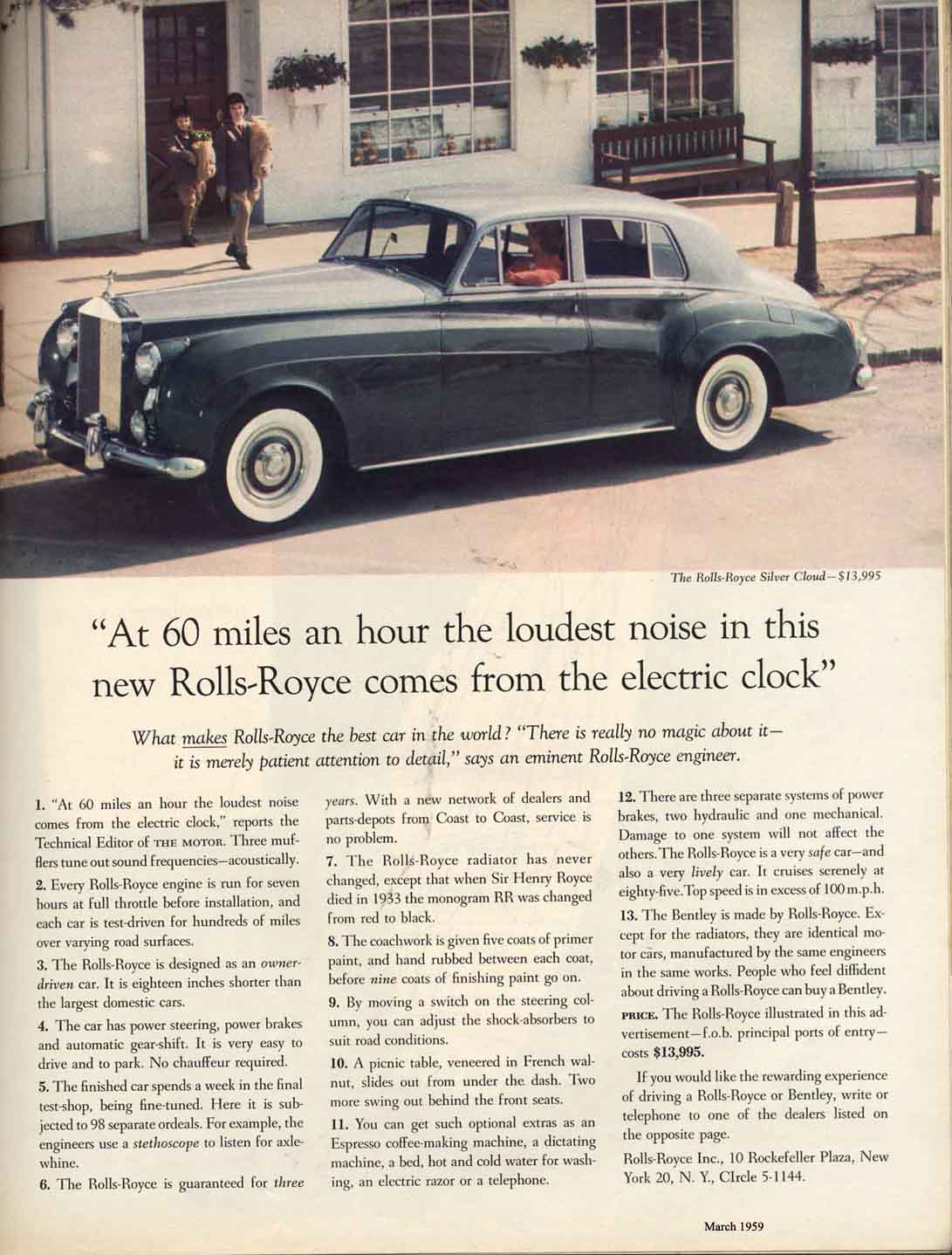

If you take away the headline, there’s nothing spectacular or remarkable about this ad. Yes, there were constraints for production and distribution in the 1950s.
Still, this is one of the most successful ads of the late 1950s. After running, Rolls Royce sales in 1958 rose 50 percent from 1957. (source) And the headline makes all the difference.
Good writing goes beyond ads. It’s also about blog posts, emails and emails you write to the people you work with.
While each medium and channel has its own specifics, here’s generally what makes for good writing:
- It’s clear
Clarity is one of the top characteristics of good writing. This means text that is easy to read and understand, containing clear and concise information. Clarity is also about having a message to convey and focusing on the main points for it and eliminating the unnecessary details. This way, readers don’t have to guess what’s happening or what it’s actually about. - It’s interesting and relevant
Good writing attracts an audience’s attention and engages it. It speaks your their language, it doesn’t sound pretentious and it doesn’t talk down to them. Also, it talks about things in a way that’s both interesting and relevant for the audience. Good writing delivers an interesting point for an audience in a meaningful way. - It provides value
Good writing also provides value. It builds on the audience’s interest and delivers something that’s relevant and valuable.
Bad writing means extra effort from the users or from your audience. And a higher chance of getting ignored, no matter the channel.
Good writing, however, tells a story. It will get people interested.
To top that, Google also likes content that’s easy to understand.
Skill no 2: Good design
Digital marketing is as much about content as it is about form.
Good writing works hand in hand with good design. Because design can seriously strengthen or undermine a message.
What’s more, design is a way to build trust with your audience.
That’s not to say you need to learn Photoshop, Sketch or whatever other tools – unless you want to.
There are a few simple things to keep in mind here:
- Use professional images
Images attract attention a lot more than text does. Whether it’s an illustration or a photo, these should be professional and high-quality – no blurry or pixelated images. To be really effective, the images should complement the point you’re trying to make with writing. Ideally, images should add to your point, featuring relevant angles and situations. - Don’t overcrowd visuals
Overcrowding visuals makes them hard to read and to understand. Effective use of whitespace is key to good design. Clean designs, in which elements don’t compete for users’ attention will reinforce your message. - Make text easy to read
Good design means structuring text in a way that’s easy to read. A clear hierarchy between headlines and body text, appropriate font sizes and a decent amount of contrast are ways to achieve readability.
Skill no 3: Building relationships
OK, this might not qualify as a skill, but…
No amount of new technologies and tools can or will save you if you keep chasing the people who are not interested.
For email marketing, emailing customers who don’t open your newsletters over and over again translates into a bad sender reputation. In turn, that increases your chances of landing in spam. Good luck getting out of there.
Likewise, showing the same ads to users who aren’t interested will actually cost you more money. Even if the relevance score is currently being phased out, there are other metrics that track the quality of your ads. Google also has a quality score for search ads.
Get to know your audience, learn what they’re interested in, what matters to them. Ask for their opinion, establish the relationship you want to have with them and keep that in mind.
This will help you be relevant, create good content and deliver value.
How will these 3 skills matter in the future?
There’s no point in repeating that digital marketing will change. We all know that.
The tools and technologies will change. Marketing automation adoption rate is pretty high. Also, artificial intelligence is poised to have an impact on pretty much about anything – digital marketing is no exception.
Besides that, new channels will emerge. Consider the last 2 years and the new stories format on Facebook and Instagram or how much social media ad spend has increased.
But just pushing new tools and technologies without the right digital marketing skills won’t make us better marketers. And it won’t keep us in business.
We should also focus on teaching how to create value and how to provide relevant information. Teach how to tell good stories in a way they’re understood and in a way they resonate.
Because in a world that gets louder and louder, you need something remarkable to actually stand out. And that takes some time to learn.
As a conclusion, I’ll leave you with another post I saw on Linkedin. It pretty much sums up my thinking about digital marketing skills:
Also, if you want to read more, check out this article on essential skills for digital careers.